Monday, May 20, 2013

Onward to Dangriga!


Happy Tuesday, Morton Belizers:

Today, we traveled to Dangriga, Belize.  On the way, we stopped by the Belize Zoo and saw many of the native animals that I discussed in yesterdays message.  My favorite were the big cats!  I am attaching a picture of Junior Buddy, a six-year old Jaguar who was born at the zoo, and was absolutely beautiful.  We were actually able to get into a smaller cage within his cage to get close enough to him and feel his fur.  I have a video of him licking my head last year, so I will have to dig it out to share with you. 

Excellent questions today, everyone.  I have so much more that I could have talked about with each of these, and I look forward to talking with you in person to discuss more about them.  For now, here is a brief explanation. 

Question 1:  What was the most important ritual?  It appears that there was no one single ritual that was more important than another.  However, one that shows up often in stone carvings is the ritual of sacrifice to keep the Gods from getting angry.  There were well over 100 Gods and Goddesses that the Mayans believed in.  Of the most important were the God of rain and harvest (Chak), fertility (Ix-Chel), and creation (Itzamna).  For example, if Chak, the rain God was angry, then the people might suffer drought, or even flooding and destroy their crops.  They needed to keep Chak happy, and this sometimes meant giving offerings of pottery, food, clothing, or sometimes offering the blood or even soul of a person.  The rituals of worship were very important for the Mayan people.

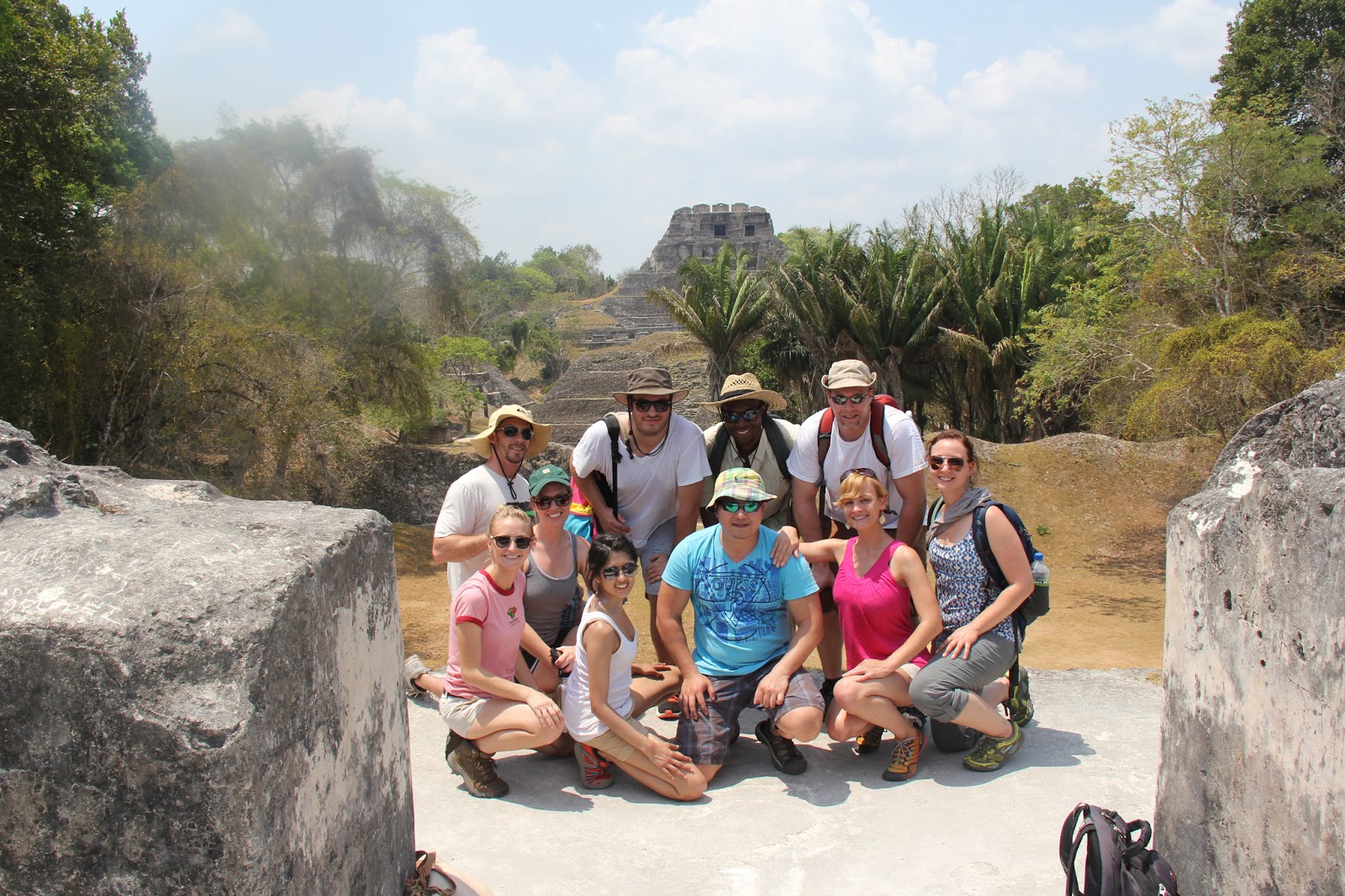
Question 2:  What do you know about the game pok-a-tok that they played in the ancient ball court and did you always die if you lost?  Ball court ruins have found in each of the Mayan city-centers.  Attached is a picture we took of the ball court at Xunantunich (in the background).  I will find a better picture to show you.   The rules have been loosely defined, but it seems that each city-center had different rules of the game, based on the layout of the courts and the stone carvings representing the games.  These carvings depict a game that was played with a very heavy rubber ball made from the sap of rubber trees.  Players had to use their elbows, shoulders, hips and knees to get the ball into a series of hoops to score points.  Sounds like a cross between basketball and soccer, doesn’t it? 

Many of these games were played with high stakes:  death.  You might think that the losers were the ones who were killed after the game, but surprisingly, there is also evidence that the winners were killed after the game.  This is hard to understand, but there was significant spiritual meaning to winning the game.  This message will get very long if I continue to elaborate, so it might be best for me to discuss this in person when I come visit on June 3rd.  Just know that winning, and therefore being sacrificed to the Gods was a major honor for the Mayan people, and therefore the players played their hardest to be the winners, and then be offered to the Gods in sacrifice.  So, to answer your question, when the games had high spiritual implications, it could have been either the losers or the winners that were killed after the game.  We can discuss this more soon. 

Question 3:  Do you have any update on the destruction of that monument?  I have not heard any updated information.  That site is a few hours north of where we are.  I do know that the landowners and construction workers could face up to 10 years in prison and 10 thousand dollars fine if they are convicted of willfully destroying the temple.  Since it is already political, that might not even happen.  Sad but true. 

Tomorrow, we are working in the city of Dangriga with the town council to determine what open spaces they have and what they can do to improve the space for public use.  After this work, we are packing up and taking a 45 minute boat ride to South Water Caye, a very small (about 9 acres) island on the Belize Barrier Reef… the second largest barrier reef in the world, second only to the Great Barrier Reef in Australia.  We will be staying two nights on the island working with the South Water Caye Marine Reserve and the Smithsonian Institution Marine Research Station on nearby Carrie Bow Caye.  While there is solar powered internet on South Water, it is very weak.  I will do my best to answer your emails over the next two nights.  If you do not hear from me, you’ll understand that the internet wasn’t strong enough to get the message out. 

Until you hear from me again, enjoy learning about Belize and the Mayan people.  I’m looking forward to hearing from you!

Dr. Chris Atchison
Georgia State University

Sunday, May 19, 2013

Weekend Exploring in Belize


Hello Morton 5th Graders!

Welcome back from the weekend.  It has been an exciting couple of days here in Belize.  I have added a few more pictures that we took this weekend. 

On Saturday, our group visited the world famous Actun Tunichil Muknal, or ATM cave.  This is a very wet cave, and we had to swim in several sections that had water over our heads!   Over 1400 artifacts from the Mayan civilization have been found in this cave, including pottery and artifacts from rituals and ceremonies.  Also found are the skeletal remains of 14 humans.  I am attaching a picture from the famous “Crystal Maiden” that is the only completely intact skeleton in the cave.  This person died over 1000 years ago!  Visitors are no longer allowed to take cameras into the cave, so I had to borrow this picture from the public domain.   All of the remains are from ceremonies of sacrifice, the people were killed to make their Gods happy. 

Sunday, we went to the ancient Mayan city-center of Xunantunich (picture).  This city began over 2000 years ago and was abandoned nearly 1200 years ago.   I have many pictures and videos to share with you.

You have perfect questions for today, because on Monday, we are visiting the Belize Zoo to see most of Belize’s native animals.

What is the official language of Belize?  Belize is a British Colony, so the official language is English.  However, being so close to Mexico, Guatemala, and Honduras, Spanish, Creole, and Garafuna are very common.  Many still speak the Mayan language in certain parts of Belize. 

What are some of the native animals?  Life is everywhere in Belize, and I have attached some pictures that we just took this weekend!  The most popular animals include Howler (picture) and Spider Monkeys, Jaguars, Iguanas (picture) 8-10 different poisonous snakes, many different types of parrots, many types of bats (picture of a small fruit bat) and tarantulas.  I was able to upload a video of the Howler Monkeys we saw at the Mayan Ruins.  The sound they make is very scary, and loud for only being about 20 pounds each!  http://www.youtube.com/watch?v=r8YUBZ4C0QY&feature=youtu.be 

I will take plenty of pictures at the Belize Zoo and show you more of the animals that can be found here. 

After the Zoo, we will be heading towards the coast and staying in Dangriga.  I am sure Mr. Schmidt has showed you a map of Belize, but you can find one here to follow us:  http://www.mapsofworld.com/belize/cities-map.html  So that you can follow along, we arrived in Belize City, have spent the first five days in San Ignacio, and will finish up our trip in Dangriga.  The Belize Zoo is near Belmopan. 

Have a great day and I look forward to hearing from you soon!

Dr. Chris Atchison
Georgia State University

Thursday, May 16, 2013

Geosciences Belize Trip 2013, Day 2


Hello Morton Middle School Belizers!

Today was a very hot day.  It was in the low 90s and very dry.  In fact, much of the country is having fires now, mostly caused by farmers slashing and burning.  The smoke is very thick.  Our eyes are burning and we are coughing a lot.  No danger from the fire though, other than it being hard to breathe, we are all safe here. 
Access to a church

We spent time working in the local community of San Ignacio today, focusing on public spaces and business (health care, banks, restaurants, playgrounds, etc) and how accessible they are for people with disabilities (see the “access" picture to the right – limited wheelchair access into a church).  We are very fortunate in the United States that every building has to be completely accessible for everyone.  Belize does not have the same standards for access.  We are creating a map of all of the information that our students have put together.  I will talk more about this if I am able to visit with you before the end of the school year. 

I have been sharing your questions with my 18 college students here, and they are all very impressed with you and your questions.  Keep in mind, you might be smarter than most of us, since we are here focusing on the environment, and less on the ancient Mayan culture.  I hope I can provide a good explanation for today’s question: 

Was there any way you could move up a level in society and if so, how and when could this occur?

Everything that I know of the ancient Mayan civilization leads me to believe that the five separate classes were very distinct, and left no opportunities for advancing to a higher class.  It was possible to fall classes, but not advance.  Everyone was  born into a class that was the same as their parents.  I do not know of any people in lower classes becoming part of the nobility, or the spiritual leaders.  Slaves could move up to peasants, if they were able to pay money to those who owned them.  Of course, since they didn’t make any money, this rarely happened. 

I am very glad that you are keeping up with current events in class.  The destruction of the Nohmul pyramid in northern Belize is really heartbreaking down here.  We have been told that it was a very political decision, since there is little money being spent on materials to pave roads.  Still, no one should ever be destroying these ancient structures, and there are people that will likely go to jail for that decision.  It is very sad.  The site was at least 2,400 years old, and is now lost forever. 

Belize School
Belize House
I am adding a few additional pictures to this message (click on them to make them bigger).  The first two pictures ("house" and "school" to the left) will show you the typical living conditions of the Belizean people.  Building resources are very hard to get here, and most will use all of the materials that they can to build their houses and schools.   
 
Lecture with Mr. Silva
The last picture ("lecture" to the right), shows our class with Mr. Hector Silva, Mayor of San Ignacio back in the 1950s and 1960s.  Mr. Silva was instrumental in bringing running water and telephone lines into most of the country.  Can you imagine living with no running water at home?  Many Belizean people still do to this day and wash their clothes in the local river and streams!  We had an interesting conversation with him on the evening we arrived. 
  
Please keep writing, I will do my best to keep answering and providing you all information about our trip.  This weekend, we are visiting one of the world famous caves of Belize, Actun Tunichil Muknal.  We will also be visiting the Mayan city center of Xunantunich, which Mr. Schmidt showed you pictures of with my students last year.  I will send you more pictures for when you come back to school on Monday along with information about the spiritual uses of caves in the ancient Mayan culture. 

Have a great weekend, everyone!

Dr. Chris Atchison (aka, Kadie’s Dad)
Georgia State University 

Wednesday, May 15, 2013

We are excited to be working virtually with Morton Middle School 5th Graders!


We are happy to announce that we will be interacting virtually with the 5th Graders at Morton Middle School in Vandalia, Ohio during our trip this year.  They will be asking us one question per day, and we will provide pictures and information about our adventures to keep them all updated about Belize and their exciting culture. 

Hello Mr. Schmidt and the Morton Middle School 5th grade class!

Greetings from San Ignacio, Belize!  Today we arrived late due to a broken airplane.  We had to wait four hours to leave Atlanta for a new plane to take us to Belize City, Belize.  But, we made it here safe and sound and I was happy to see an email message from you all.  

I think Mr. Schmidt showed you a few pictures from our previous trips to Belize.  We will be visiting some of the same sites this time, and I will be sure to explain a little more about those pictures when we get to them.  Currently, Belize is two hours behind you all in Vandalia.  So when you email me, I will likely have to respond towards the end of the day.  You'll have a message waiting for me each morning that we are here.  
 
Let’s get right to your question:  “Do you think the Mayan people ever had a female ruler”

While this was a very rare occurrence, I do know of at least one female ruler in the history of the Mayan civilization.  The reason this is so rare is because Mayan leadership was passed down from Kings to sons.  This is especially true for Mayan Priests and spiritual leaders.  Mayan families were very large, and the royal families were typically quite large, with many sons and daughters.  Rulers passed down leadership to the eldest sons first.  In the case that there were no sons, the eldest daughter could have been named the ruler, unless nephews of the ruler were named. 

So, fear not girls, since we vote on our governmental leadership in the United States, you all have a great opportunity to be the leader of our country, so go for it! 

I will be updating our blog page with pictures from the trip, so please check back often to read about our adventures and see new and exciting pictures from our journey.   We will do our best to update this page with information and pictures daily for each of you to follow along.  Feel free to email me any questions you might have, and hopefully I can come in and speak with you all when I return. 

I look forward to hearing back from you soon.

Dr. Chris Atchison
catchison@gsu.edu 

Monday, May 13, 2013

It's time.  We leave Wednesday.  Two days of GIS preparations in the lab at Georgia State University, then we arrive in Belize City first thing Wednesday.  Wed-Sun in San Ignacio, then M-F in Dangriga and South Water Caye.  Get ready, Belize!

Saturday, May 12, 2012

the circus is in town, and no it’s not us...

As an added treat, the largest circus in Central America (so they claim) has rolled into town.  Some of us will check it out in the free time.

Yesterday, we had a great meeting with the Cornerstone Foundation about a health accessibility mapping project to benefit the people of San Ignacio.  Students listened attentively to the lecture led by the foundation’s director.  They then developed a plan to identify different GIS layers needed to suppport the data requests of the Cornerstone Foundation.  the students quickly learned that unlike most US GIS projects there is not much readily available data.  Thus, they headed into the field in small groups to interview residents, collect GPS points, document attribute data, and create field notes for later inclusion in GIS.  By most accounts it was a hot, but interesting day.  What’s most exciting is I think the students came up with a creative analysis of the problems identified by the Cornerstone Foundation.  The student maps will be directly shared with the community and the Cornerstone Foundation in the next few weeks.
In the evening, we had some free time.  About half the group went on a night hike through the jungle.  It was not so good. The animals were not having it, so we didn’t see much.  Saw some scorpions, ants, frogs, a toad, an owl, and a bunch of very small spiders.  Other students stuck around town and had some dinner and fun.
Today we woke up and headed out to Cahal Pech (a Maya ruin site).  Students again created sketch maps and detailed field notes about another important tourism hotspot.  Great stuff.  I then went rogue and off script like Joe Biden.  We took a trip to Rodriguez’ Roadside Chicken Stand (owned by the brother of our driver: Ramone).  I sprung for lunch since I poorly communicated the wake up times two days in a row!  We had great barbecue chicken, a loveley lime drink, and some fresh tortillas.  It hit the spot and brought most spirits back up. 
Now the students are out in the field collecting data for the final projects. 
Tonight we head to the Village of San Antonio for a traditional Maya dinner.  Should be delicious and relaxing.
Tomorrow we head to Mountain Pine Ridge.  It’s a challening trip for all of us especially with the heat, but I think overall its going well.  More soon from a sun burnt, excited and sore professor.
Tim


Thursday, May 10, 2012

Day 2 in the books

Our first full day in San Ignacio is officially in the books.  Today we spent a very hot morning at the Mayan site of Xunantunich followed by some cave tubing at Jaguar Paw.  Both of these stops were meant to showcase two of Belize's top income by tourism attractions.  Tonight, the students are required to post to their journals a reflection of how the use of GIS would assist and enhance the tourism of Belize through these two specific attractions. 

While at Xunantunich, the students were collecting GPS points of several of the ruins, and also recording relevant qualitative information about the village, Mayan culture (rituals, games, etc.) as well as the overall layout of the community and features of the physical environmental.  A brief sketch of the surroundings and the layout of the village was collected in data notebooks, all to be collected together as layers of information in GIS later this week.  I must point out, that we still didn't see any monkeys, and my feeling that Tim Photoshopped them into his promotional pictures is growing stronger. 

Tomorrow, we head to the Mayan site of Cahal Pech in the morning to do similar data collection.  Then in the afternoon we will meet with the Cornerstone Foundation to begin collecting and creating a healthcare map of downtown San Ignacio for their clients. 

Moving right along. 

Chris